
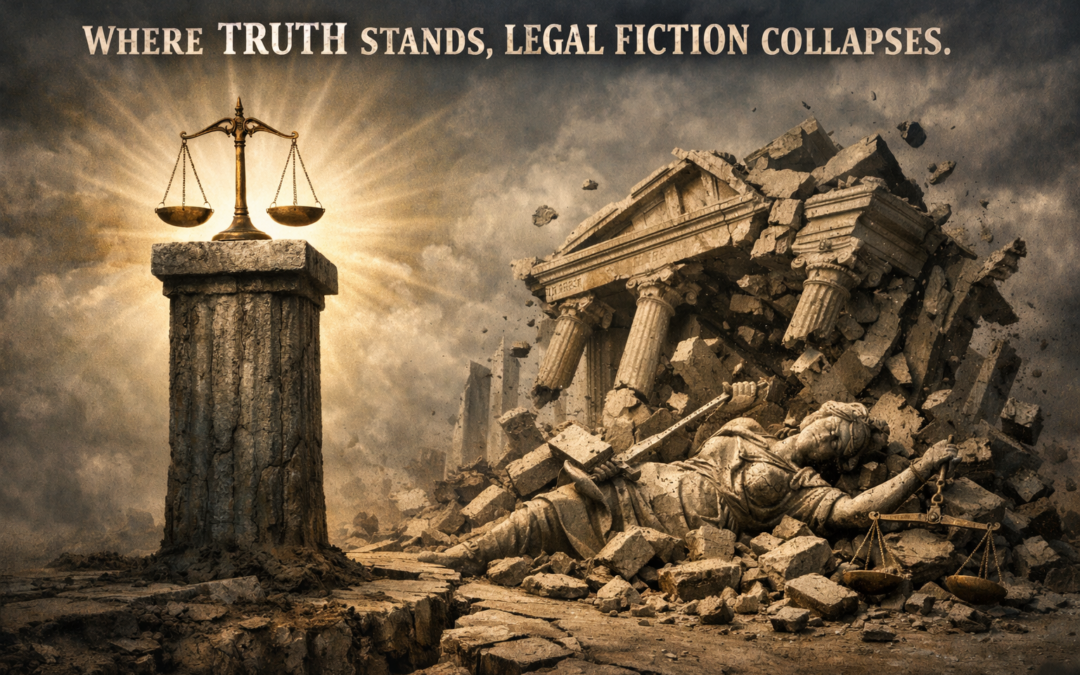
Truth Does Not Argue With Paper: Standing Under God Without Becoming a Subject of Fiction
Brief description:
A clarified and corrected theological–legal reflection explaining why Truth does not contend with state legal fiction, correcting the Temple tax reference, affirming the state’s obligation to administer its own statutory instruments, and grounding the believer’s posture in Scripture, canon law, election, and the maxim Nemo militans Deo implicat se negotiis saecularibus.
Corrected and expanded discussion (full narrative):
Truth does not argue with state legal fiction. Truth stands. It makes peace without conceding identity. It is subject to God as the higher power while refusing to become a subject of man-made legal constructs.
First, a necessary correction must be stated plainly and accurately. When Jesus paid the tax in Matthew 17:24–27, this was not a Roman civil tax. It was the Jewish Temple tax—the half-shekel required for the upkeep of the Temple under Mosaic custom. Christ explicitly distinguished His standing from the obligation itself when He said, “Then are the children free.” The payment was made not because He was bound, but “lest we should offend.” This was not submission of identity; it was a voluntary act of peace within a religious administrative system while affirming freedom from obligation.
This distinction matters. Christ did not concede that the Temple tax defined who He was in fact and truth. He demonstrated that Truth can cooperate without being owned, and can comply without being bound.
Likewise, Truth today does not need to fight state records. A birth record is an administrative instrument, not a creator. The ultimate obligation to administer the birth-certificated statutory person lies with the issuer, not with the child, and not with the man created by God. The state created the instrument; therefore the state bears responsibility for its administration.
Further, the secular state provides the administrative birth-certificated statutory instrument for its own purposes—to allow the issuers to manage, maintain, and account for population data, public order, and legal economics. The instrument exists to serve the system that issued it. It does not exist to define the soul, spiritual truth, fact and reality, or standing of the man before God. Participation in administrative personhood is therefore an elective choice, not a spiritual obligation. A man may act in administrative capacity if he so chooses, or he may decline identification with it—without rebellion, and without conflict.
This stands as non est factum, both in examination and in effect.
Non est factum means “this is not my deed.” The living child did not author, consent to, or execute the statutory instrument at birth. Capacity did not exist. Knowledge did not exist. Assent did not exist. No later presumption can cure that defect.
Further still, any attempt to bind the living man retroactively is ex post facto in nature. A presumption applied after the fact cannot lawfully convert an administrative record into a personal obligation of the creation of God.
Truth does not argue these points in courts of fiction. Argument assumes jurisdiction. Argument accepts the premise that the paper has authority over life. Truth does not accept that premise. Truth simply withdraws from acting as administrator for legal identification while remaining peaceful. It does not rebel. It does not protest. It does not wage war. It refuses false animation.
Scripture supports this posture without ambiguity. Romans 13 speaks of being subject to higher powers for the sake of order—not of surrendering spiritual truth, fact and reality to administrative systems. Jesus rendered what belonged to Caesar precisely because who He was in fact and truth did not belong to Caesar. The realms were separated. The payment did not define the person.
Christ Himself makes the division unmistakable: “No man can serve two masters” (Matthew 6:24). Administrative systems demand service, accounting, and performance. God demands the heart. “Whosoever he be of you that forsaketh not all that he hath, he cannot be my disciple” (Luke 14:33). This is not a call to chaos, but to undivided allegiance.
This is why Scripture also commands: “Wherefore the rather, brethren, give diligence to make your calling and election sure” (2 Peter 1:10, KJV). This instruction is not about earning salvation, but about confirming it through ordered, outward life. Calling is God’s invitation. Election is God’s choosing. The believer does not create either—but is instructed to make them sure through conscious diligence.
“Give diligence” requires active, intentional effort.
“Calling and election” are confirmed, not by paperwork, but by fruit.
“Make… sure” means to strengthen assurance, not to bargain for favor.
“And ye shall never fall” speaks to stability—freedom from confusion, doubt, and divided service.
Peter lists the marks of this confirmation: faith, virtue, knowledge, temperance, patience, godliness, brotherly kindness, and charity. These are not administrative credentials. They are evidence of allegiance.
This separation of realms is also made explicit in a long-recognized Latin maxim derived directly from Scripture:
Nemo militans Deo implicat se negotiis saecularibus.
Translated: “No one fighting (or serving) for God entangles himself in secular affairs.”
This maxim comes from 2 Timothy 2:4, preserved in the Latin Vulgate, and was widely used throughout the Middle Ages and into the early modern period, particularly in canon law. It affirmed that those devoted to God must not be entangled in secular administration, commerce, or political machinery, lest divided loyalty corrupt the calling.
Its meaning is precise and uncompromising. A man serving God cannot be animated by secular instruments. He may pass through the world, but he cannot be entangled by it. He may comply in peace, but he cannot become property.
Truth therefore does not fight paper.
Truth does not argue with registrars.
Truth does not attempt to “win” inside a fictional arena.
Truth stands under God alone.
It leaves the administration of fiction to its issuer.
It makes its calling and election sure.
And it walks free—quietly, lawfully, and without fear.
That is not resistance.
That is obedience.
And obedience to God requires no argument with ink.