
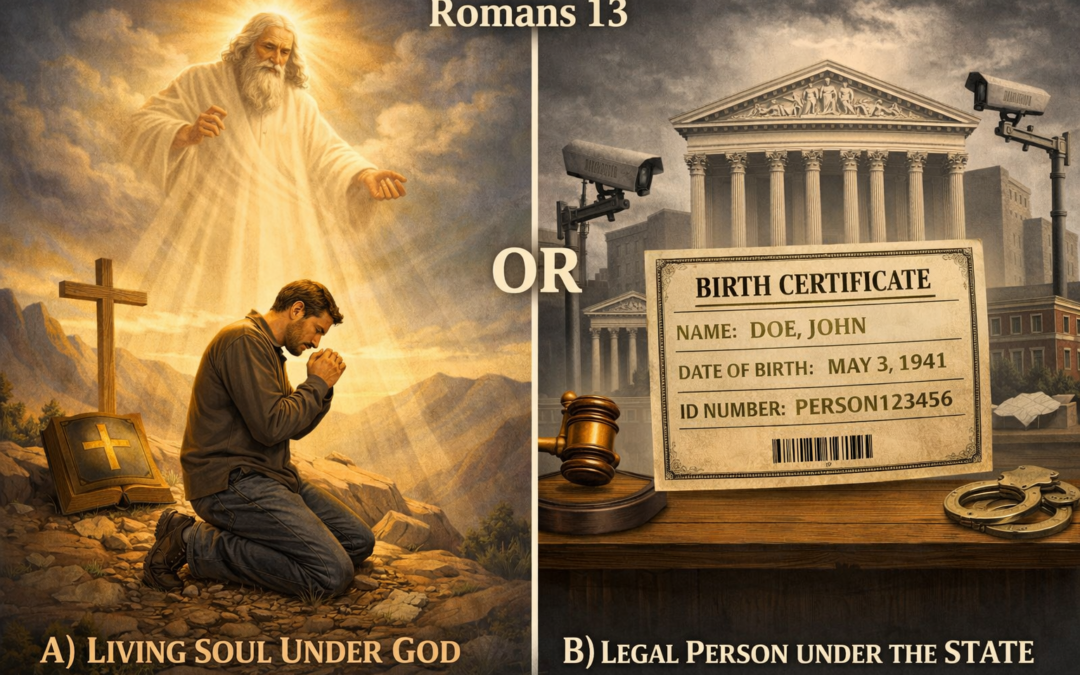
Two Realms, One Conscience: Paul, Power, and the Line the State Cannot Cross
A Supreme Thesis
Let me start with this—because if you miss this opening, you will misunderstand everything that follows.
Most men think Romans 13 is about obedience.
It isn’t.
It is about order—and more importantly, about limits.
Because the moment you forget where authority ends,
you don’t create peace—
you create idolatry.
Paul knew this.
And I speak today in that same spirit.
There are two realms, not one.
And all confusion—legal, spiritual, and personal—comes from mixing them.
God governs the soul.
The state governs the person (human, citizen).
These are not enemies.
They only become enemies when one trespasses into the domain of the other.
The soul is breathed by God.
It answers to conscience.
It stands before judgment.
It cannot be registered, taxed, fined, imprisoned, or transferred.
No empire has ever touched it.
The person, however, is different.
The person is an instrument of order.
A civil construct.
A surname (added to your God given name) used for counting, accounting, and administration among men.
Paul understood this distinction perfectly.
When he spoke of the inner man, he spoke of what no ruler could reach.
When he spoke of law, he spoke of restraint upon outward conduct.
The state holds no key to the soul.
It only holds keys to records, roles, and responses.
Now hear this carefully.
Romans 13 authorizes administration—not ownership.
Paul does not say rulers own men.
He does not say authority creates being.
He does not say conscience is transferred.
He calls rulers ministers.
Not masters.
Not creators.
Not gods.
A minister serves what he did not create.
A steward manages what is not his.
Administration is not possession.
Paul himself appealed to Roman administration when it served justice—
and refused it when it trespassed upon obedience to God.
That alone tells you everything you need to know.
Authority is limited.
Functional.
Conditional.
Not spiritual.
Not creational.
Not absolute.
Paul speaks of subjection, not worship.
Compliance—not identity.
Order—not origin.
Subjection applies to roads and courts.
To taxes and boundaries.
To peacekeeping among men.
It does not apply to conscience.
It does not apply to faith.
It does not apply to repentance or salvation.
And here is where history matters.
To confuse these realms is to make Caesar what he did claim to be—
but what he was never entitled to be: a god.
The emperors demanded worship.
Paul refused that transfer.
And so must we.
Paul never taught that obedience to rulers meant belonging to them.
Only that chaos benefits no one.
Here is the harmony Paul assumed—and expected believers to understand.
God governs who you are.
The state governs what you do outwardly.
Christ governs why you act.
When each remains in its place, there is peace.
Conflict only begins when the state claims the soul—
or when the soul rejects all civil order.
Paul condemned both errors.
So the conclusion is simple.
Render what is due.
Keep your conscience clear.
Do not confuse service with surrender.
Do not confuse order with ownership.
The state may number the person.
But only God names the soul.
And Paul never mistook the two.
Neither should we.